Meet the elusive big cat of Pakistan’s northern mountains, and discover how ordinary people can help keep it alive.
Imagine standing on a windswept ridge in Gilgit-Baltistan, thousands of metres above sea level. The air is thin, the rocks are sharp, and the silence is enormous. Somewhere on the slope across from you, a pair of pale eyes may be watching. You will almost certainly never know it. This is the world of the snow leopard, a cat so shy and so perfectly camouflaged that local communities and researchers alike have long called it the “mountain ghost.”
If you have never studied wildlife before, don’t worry. This guide is written for beginners. We will walk through what a snow leopard is, how it survives in some of the harshest terrain on Earth, where it lives in Pakistan, why it is in trouble, and what everyday people can do to help. By the end, we hope you will feel a little more connected to this remarkable animal that shares our northern mountains.
Meet the Mountain Ghost
The snow leopard (Panthera uncia) is a large wild cat that lives in the high mountains of Central and South Asia. In Urdu it is often called barfani cheetah or barfani tendua, which simply means “snow leopard.” Despite the name, it is not a close cousin of the common leopard you may have seen in pictures from the forests of Margalla Hills or Africa. It is its own species, adapted to a completely different life.
An adult snow leopard is a medium-to-large cat. Most weigh somewhere between 22 and 55 kilograms, with males usually heavier than females. That makes it smaller than a lion or tiger, but do not let the size fool you. It is strong, muscular, and able to bring down animals much larger than itself.
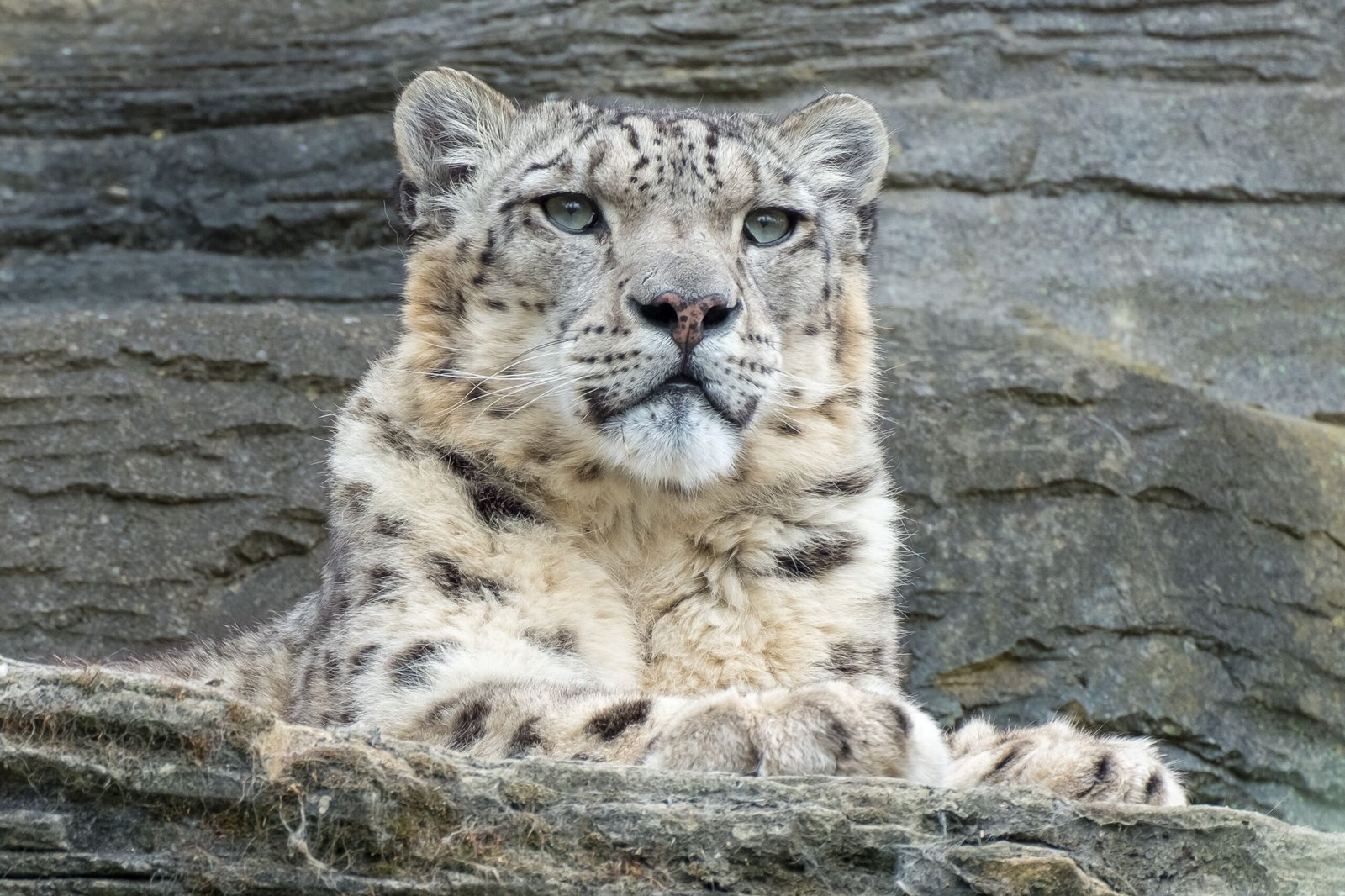
What really sets the snow leopard apart is its appearance. Its thick coat is a smoky grey or pale cream colour, covered in dark grey rosettes and spots. Against bare rock, patches of old snow, and shadow, that pattern breaks up the cat’s outline so well that even experienced wildlife watchers can stare straight at one without seeing it. Many photographers spend weeks in the field and come home without a single glimpse.
That difficulty is exactly why the snow leopard has become a symbol of wild, untouched mountain country. If the ghost is still out there, the mountains are still healthy.
Built for Life in the Mountains
Snow leopards live where most animals would struggle to survive. Temperatures can drop far below freezing, the oxygen is thin, and the ground is steep and rocky. Over thousands of years, evolution has equipped the snow leopard with a remarkable set of tools.
A coat like a winter jacket. The fur is dense and long, and the belly fur can grow especially thick to protect the cat when it rests on frozen ground. The cat’s thick fur keeps it warm even when the wind howls across a ridge.
A built-in scarf. The snow leopard’s tail is very long, often nearly as long as its body, and it is thick and furry. When the cat curls up to sleep, it wraps its tail around its nose and face like a warm scarf. The tail also works as a balancing pole when the cat dashes along narrow ledges.
Snowshoe paws. The paws are large and wide, which spreads the cat’s weight on deep snow, much like a snowshoe. The soles are also covered in fur, which adds grip and warmth.
Powerful back legs. Snow leopards are famous jumpers. They can leap many metres across gaps in a single bound. Reports often mention horizontal jumps of up to around 15 metres, which is longer than a school bus. That strength helps them chase prey over broken ground and cross ravines that other predators would have to walk around.
A nose built for cold air. Their nasal passages are short and wide, which helps warm and moisten freezing air before it reaches the lungs. This is useful at high altitude, where the air is both cold and thin.
A voice that does not roar. Unlike lions and tigers, snow leopards cannot roar. Instead they make softer sounds, including mews, growls, hisses, and a friendly-sounding “chuff.” Some researchers describe a unique puffing sound used between cats that know each other. Because they live alone and in quiet places, even these small sounds can carry a long way across a valley.
A Day in the Life of a Snow Leopard
Snow leopards are most active around dawn and dusk, which scientists call being crepuscular. During the middle of the day, they often rest in shaded rocky spots, where their coat blends in perfectly. At night they travel, sometimes covering long distances, checking familiar routes along ridgelines and cliff edges.
What do they eat?
The snow leopard is a carnivore, and its menu depends on where it lives. In the mountains of Pakistan, its natural prey includes:
- Siberian ibex, a large wild goat with dramatic curved horns
- Markhor, Pakistan’s national animal, a wild goat famous for its spiralling horns
- Blue sheep (bharal) and Ladakh urial, in parts of the range
- Marco Polo sheep, in the far northern valleys
- Smaller animals like marmots, hares, and game birds
A snow leopard can kill an animal about three times its own body weight, and one large kill may feed the cat for several days. This is why a healthy population of wild mountain goats and sheep is so important. No wild prey, no snow leopards.
Hunting like a ghost
Snow leopards are ambush hunters. They use the terrain to creep close, staying low and hidden among rocks. When the moment is right, they charge downhill and surprise their prey in a short, explosive rush. Because the mountain slopes are steep, gravity gives them a boost.
A mostly solitary life
Adult snow leopards generally live alone. Each cat uses a large home range, and the size depends on how much prey is available. In areas with fewer wild animals, a cat may need a very large area to find enough food.
Since they rarely meet face to face, snow leopards leave messages for each other. They scratch the ground to make marks called scrapes, spray scent on rocks, and rub their cheeks against boulders. These signs tell other cats who has passed through and when. For researchers, these same signs are valuable clues. Scat (droppings), pugmarks (footprints), and scrapes help scientists learn about a population without ever seeing the animals.
Raising cubs
Snow leopards usually mate in late winter, and females give birth in a hidden rocky den in spring or early summer. A litter commonly has two or three tiny cubs, which are born helpless and covered in thick, smoky fur. The mother raises them alone. For roughly the first couple of years, the cubs stay close, learning how to stalk, climb, and hunt. Not every cub survives. Life at high altitude is tough, and the mother must leave her cubs alone while she hunts, which makes them vulnerable.
Because females raise only small litters and not every year, snow leopard numbers recover slowly when they decline. That is one reason why protecting adult cats is so important.
Where Snow Leopards Live: Pakistan’s Northern Mountains
Snow leopards roam across twelve countries in Asia: Afghanistan, Bhutan, China, India, Kazakhstan, Kyrgyzstan, Mongolia, Nepal, Pakistan, Russia, Tajikistan, and Uzbekistan. Pakistan is a special part of this puzzle, because three of the world’s greatest mountain ranges meet here: the Himalaya, the Karakoram, and the Hindu Kush.
In Pakistan, snow leopards are found mainly in:
- Gilgit-Baltistan, including areas around Hunza, Shimshal, Skardu, Astore, and the Karakoram
- Chitral in Khyber Pakhtunkhwa, along the Hindu Kush
- Parts of Azad Jammu and Kashmir and the high valleys near the Himalaya
They tend to prefer steep, rugged land with cliffs, ridges, and rocky outcrops, often between roughly 3,000 and 4,500 metres above sea level. In winter, some cats follow their prey down to lower slopes, which is when local people sometimes get a rare sighting.
Protected places such as Khunjerab National Park, Central Karakoram National Park, and Chitral Gol National Park provide important habitat. Many other snow leopard areas are not formally protected at all and lie within community-managed pastures, which makes local support vital.
How many are left?
No one knows the exact number of snow leopards. They are so hard to count that scientists rely on camera traps and genetic analysis of scat. Estimates for the global wild population are generally given as a few thousand cats, commonly somewhere between 4,000 and 6,500. For Pakistan, estimates have usually been in the low hundreds. The numbers vary between surveys, and researchers are still improving the methods. What nearly everyone agrees on is that the species is rare and needs careful protection.
The International Union for Conservation of Nature (IUCN) lists the snow leopard as Vulnerable, meaning it faces a high risk of extinction in the wild if threats continue. Gilgit-Baltistan has also adopted the snow leopard as a proud symbol of the region.
Why the Snow Leopard Matters
You might wonder: why should we care about one rare cat in far-off mountains? There are a few important reasons.
It is an “indicator” species. The snow leopard sits at the top of the mountain food chain. When snow leopards are doing well, it usually means there is enough prey, healthy grasslands, and a stable ecosystem. When they disappear, it is often a warning sign that something is wrong.
It protects the water we depend on. The high mountains where snow leopards live are the source of glacier-fed rivers that flow into the Indus basin. Millions of people in Pakistan depend on this water for drinking, farming, and electricity. Protecting snow leopard habitat means protecting the pastures, wildlife, and watersheds that keep those rivers healthy.
It belongs to our culture and identity. For communities in the north, the snow leopard is part of local stories, folklore, and pride. Losing it would mean losing a piece of our natural heritage.
It supports livelihoods. Wildlife tourism, trekking, and guiding bring income to remote valleys. A living snow leopard can be worth far more to a village than a dead one.
What Threatens the Mountain Ghost?
The snow leopard may look invincible, but it faces serious challenges, and most of them involve people.
1. Conflict with herders
For families in mountain villages, livestock such as goats, sheep, and yaks are their savings and their future. Sometimes a snow leopard slips into a poorly protected pen at night and kills many animals in a single attack. For a family with few resources, that is a heavy loss. In anger or desperation, some herders retaliate. This is one of the biggest threats to snow leopards across their range, and it is important to treat it with understanding. The herders are not villains; they are people trying to protect their income.
2. Loss of natural prey
When wild ibex, markhor, and sheep are hunted illegally or driven away by overgrazing, snow leopards have less to eat. A hungry cat is more likely to turn to livestock, which fuels the conflict above.
3. Poaching and illegal trade
Snow leopards are protected by law, but they are still hunted in some places for their fur and body parts. Strong law enforcement and community vigilance are key to stopping this.
4. Climate change
Mountains are warming quickly. As temperatures rise, the tree line can creep higher and glaciers retreat, which may shrink the cold, open habitat where snow leopards and their prey live. Scientists are still studying exactly how this will play out, but the concern is real.
5. Roads, mines, and development
New roads, mining, and large infrastructure can cut through snow leopard habitat, disturb prey, and make it easier for poachers to reach remote areas. Development is important for communities, but it needs careful planning to leave room for wildlife.
Good News: People Are Making a Difference
The story of the snow leopard is not only about problems. In Pakistan, there are encouraging examples of people working together.
Community-based conservation. Organisations such as the Snow Leopard Foundation, WWF-Pakistan, and other partners work with mountain communities to protect wildlife in ways that also help families. Villagers are trained as wildlife monitors, and community groups help manage hunting and grazing so that both people and animals benefit.
Predator-proof corrals. One simple but powerful idea is to strengthen livestock pens with sturdy walls and roofs so that a leopard cannot get in. When the animals are safe at night, losses drop, and so does the reason for revenge killings.
Livestock insurance and compensation. In some valleys, community-run insurance schemes help families recover if a snow leopard kills their animals. Villagers contribute to a shared fund, and conservation groups help support it. In return, the community agrees to protect the cats. It is a practical way of showing that living alongside wildlife can be fair.
Trophy hunting and community benefits. In parts of northern Pakistan, regulated hunting programs for ibex and markhor have been used to generate income for local communities, with a share going to conservation. These programs are debated by different groups, but supporters point out that they have helped local people see wild animals as valuable and have contributed to recoveries in some markhor populations. This, in turn, supports the snow leopard’s food supply.
Research with camera traps. Scientists place motion-triggered cameras along ridgelines and trails. Over time these cameras have captured amazing images of snow leopards, mothers with cubs, and even rare interactions. This information helps decide where to protect land and how to design better programs.
Global cooperation. In 2013, the twelve snow leopard range countries joined together under the Global Snow Leopard and Ecosystem Protection Program, promising to work across borders to secure the species and its habitat. Every year, International Snow Leopard Day on 23 October is also celebrated to raise awareness about the animal.
How You Can Help (Even If You Live Far from the Mountains)
You do not need to be a scientist or a mountaineer to make a difference. Here are some simple ways to support snow leopards:
- Learn and share. Talk to friends and family about the snow leopard. Awareness is the first step toward protection. Sharing this article is a good start.
- Support trusted conservation groups. Consider donating to or volunteering with organisations that work on snow leopards in Pakistan and across Asia.
- Choose responsible tourism. If you travel to the north, pick local guides and homestays, follow park rules, keep noise low, and never leave rubbish behind. Money spent in local communities helps show that wildlife is worth protecting.
- Respect wildlife. Never chase, feed, or crowd animals, and do not buy products made from wild animal fur or body parts.
- Reduce your carbon footprint. Climate change affects mountains first and fastest. Small steps, like saving energy and reducing waste, add up.
- Teach children. Stories, drawings, and school projects about snow leopards help the next generation grow up caring about wildlife.
Tips for travellers hoping to see one
It is worth being honest: seeing a snow leopard in the wild is extremely rare, and most visitors will not. Specialised wildlife tours with trained trackers do exist in some parts of the world, and they involve long days in cold, high-altitude conditions. If you are travelling in the north of Pakistan, try to enjoy the whole experience: the landscapes, the people, the food, and the other wildlife such as ibex, marmots, and birds of prey. If a snow leopard does appear, consider it a gift, keep your distance, and stay quiet.
Snow Leopard Myths vs. Facts
Myth: Snow leopards are a type of regular leopard. Fact: They are a separate species, adapted for cold, rocky, high-altitude life.
Myth: Snow leopards attack people. Fact: Attacks on humans are extremely rare. Snow leopards are shy and avoid people.
Myth: They can roar like lions. Fact: Snow leopards cannot roar. They make softer sounds like mews, hisses, and chuffs.
Myth: There are plenty of them because we never see them. Fact: The opposite is true. We rarely see them because they are naturally secretive, and also because there are not many left.
Myth: Protecting snow leopards hurts local people. Fact: When conservation is designed together with communities, it can bring benefits such as income, safer livestock, and healthier pastures.
A Few Quick Questions
Are snow leopards dangerous? They are powerful predators, but they avoid humans and almost never attack people. The main conflict is with livestock, not people.
How long do snow leopards live? In the wild they are thought to live around 10 to 12 years or somewhat longer, while cats in zoos can live notably longer.
Can you keep a snow leopard as a pet? No. They are wild animals protected by law, and they need vast, rugged habitat to survive.
When is the best time to learn more? Right now! International Snow Leopard Day on 23 October is a great opportunity to read, share, and support conservation efforts.
Final Thoughts: Keeping the Ghost Alive
The snow leopard is more than a beautiful animal. It is a living signal that our northern mountains are still wild, still balanced, and still full of life. It reminds us that nature’s strongest creatures still depend on the choices people make: how we treat our pastures, how we share space with wildlife, and how we care for the glaciers and rivers that feed our country.
Protecting the mountain ghost is not only the job of scientists or governments. It begins with curiosity, grows with understanding, and succeeds when communities, conservationists, and everyday readers like you work together. Every story shared, every responsible trip, and every small act of care helps give the snow leopard a future.
So the next time you look at a photograph of the Karakoram or the Hindu Kush, remember that somewhere up there, quietly watching from the rocks, a ghost is still walking the mountains. Let’s make sure it never disappears.
Have you ever visited northern Pakistan, or heard a local story about the snow leopard? Share your experience in the comments below. We would love to hear it!